

Taking care of your pet’s ear infection
Ear infections can be triggered by allergies, foreign bodies (such as grass seeds), or a polyp or tumour in rare cases. Wetting of the ear canal from swimming or bathing can make ear infections worse, leading to infections from bacteria and/or yeast (fungal) organisms.
Ear infections can be very uncomfortable for your pet. Itchy ears or red and warm ear flaps are a sign of an ear infection. Ear infections cause long-term damage to the ear canals if not treated properly.
Recurring ear infections lead to changes in the ear that may require surgery. Our specialist dermatologists have developed ways of managing ear problems to avoid the need for surgery in most cases.

Does my pet have an ear infection?
Ear infections can be uncomfortable and sometimes very painful for pets. While some infections are easy to spot, others begin with subtle changes in your pet's behaviour.
Common signs of an ear infection or ear inflammation include:
Redness or warmth of the ear flap or ear canal
Head shaking or frequent tilting of the head
Scratching or rubbing at the ears, head or face
Pain or sensitivity when the ears or head are touched
An unpleasant smell coming from the ear
Visible discharge, which may be brown, yellow, creamy or dark in colour
Holding one ear differently, including keeping an affected ear lowered
Restlessness or changes in behaviour due to discomfort
Reluctance to have the ears examined or handled
Thickening or narrowing of the ear canal in pets with long-term ear disease
Some pets show only one or two of these signs, particularly in the early stages.
How are ear infections diagnosed?
Diagnosing an ear infection involves more than simply looking inside the ear. At Animal Dermatology Clinic, we assess both the infection itself and the underlying factors that may be causing it to persist or return.
Cytology is an important part of this process. A sample of material from the ear is examined under a microscope to identify organisms such as bacteria or yeast and help determine the most appropriate treatment.
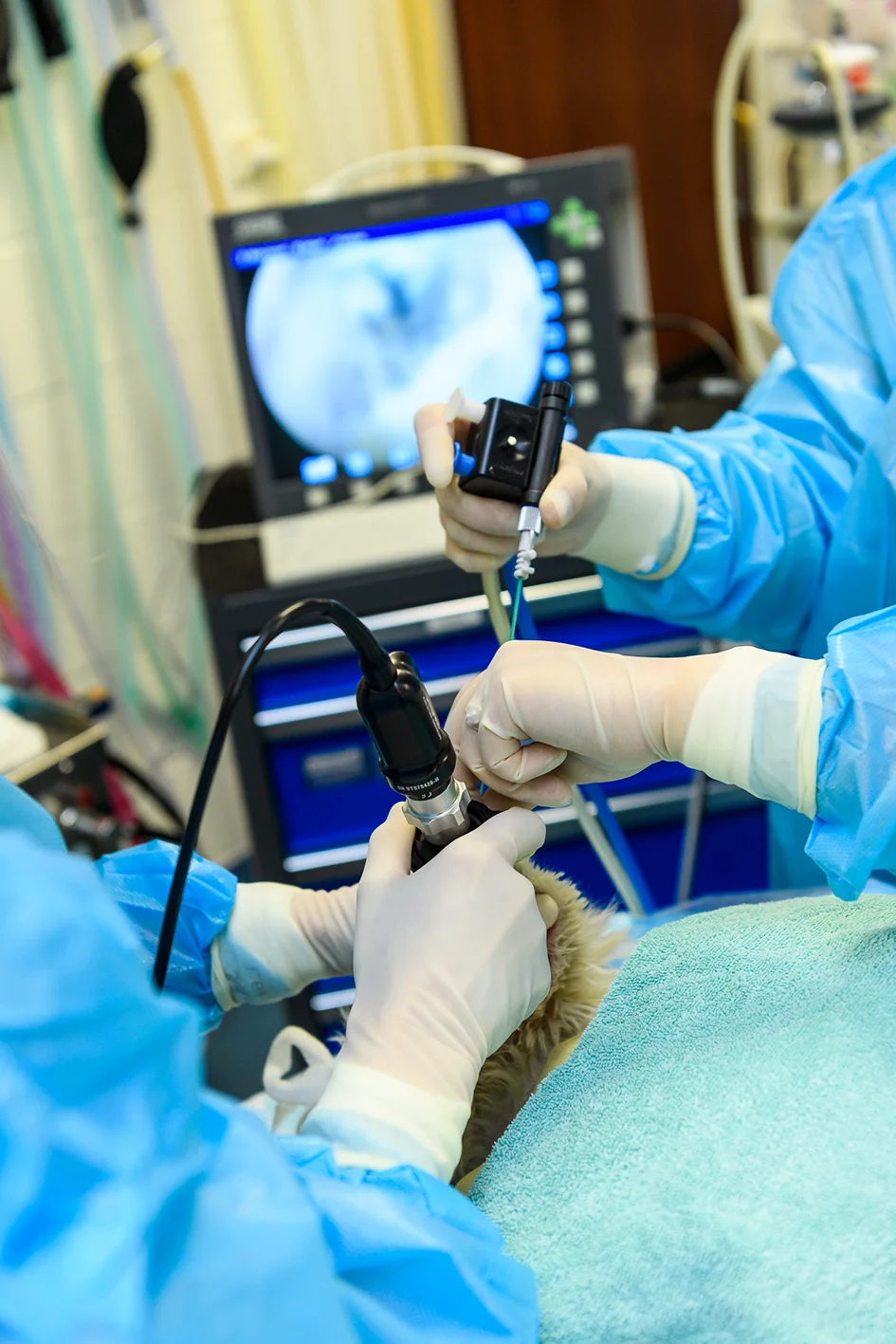
For recurrent, severe or difficult-to-treat ear disease, we may recommend video otoscopy. This specialised equipment provides a magnified, detailed view deep within the ear canal and allows our veterinary dermatologists to assess areas that can be difficult to visualise during a routine ear examination, including the eardrum.
Video otoscopy can also be used to thoroughly flush and clean the ear canal, collect targeted samples and perform specialised procedures when required.
If we suspect disease involving deeper structures of the ear, advanced imaging such as a CT or MRI scan may be recommended. We can also arrange hearing assessment when appropriate.
How should ear infections be treated?
Treatment depends on what is causing the infection, how severely the ear is affected and whether there is an underlying condition contributing to the problem.
After examining the ears and performing cytology, we can select treatment appropriate to the type of infection present. This may include topical ear medication, systemic medication or other treatment depending on your pet's individual needs.
For chronic or recurrent ear infections, medication alone may not be enough. The ear canal can become narrowed and inflamed, and accumulated discharge or debris can make treatment more difficult.
In these cases, a thorough ear flush under anaesthesia using video otoscopy may be recommended. This allows us to carefully examine and clean the ear canal, assess the eardrum and perform additional diagnostic or treatment procedures where necessary.
Just as importantly, we investigate why the ear infection keeps returning. Recurrent ear disease can be associated with underlying problems such as allergies, inflammatory skin disease, foreign material, growths or changes within the ear canal. Identifying and managing these contributing factors is an important part of achieving better long-term control.
Why does my pet keep getting ear infections?
An ear infection is often not the whole problem. Bacteria or yeast may be responsible for the infection itself, but there is frequently an underlying reason the ear has become inflamed and susceptible to infection.
Recurring ear problems can be associated with conditions such as allergies and other inflammatory skin diseases, as well as foreign material, growths or changes within the ear canal.
This is why repeatedly treating an infection without investigating the underlying cause may provide only temporary relief.
Does my pet need a veterinary dermatologist?
Your local veterinarian is well equipped to diagnose and treat many straightforward ear infections. However, some ear conditions become more complex and benefit from specialist investigation and treatment.
A referral to a veterinary dermatologist may be recommended if your pet:
Has ear infections that repeatedly return
Has an infection that isn't responding as expected to treatment
Has significant pain, inflammation or narrowing of the ear canal
May have a damaged or abnormal eardrum
Is suspected of having disease involving the middle ear
Requires specialised diagnostic or treatment procedures
Has an underlying allergy or skin condition that may be contributing to recurring ear disease
Complex ear disease can require specialised equipment, advanced diagnostics and dermatology-specific experience that may not be routinely available in general veterinary practice. Video otoscopy, for example, requires specialised equipment as well as experience in examining and performing procedures within diseased ears.
Our veterinary dermatologists have extensive experience investigating and managing chronic and complicated ear disease, with access to video otoscopy and advanced diagnostic options when required.
Referral doesn't replace your regular veterinarian. We work alongside your vet, providing additional expertise and specialised facilities when an ear condition requires further investigation or treatment, and helping develop a longer-term plan to keep your pet's ears as healthy and comfortable as possible.
Worried about your pet? Give us a call. We treat your pet like one of our own. Call now on: +61 08 6277 9430 (Murdoch) and (Balcatta) or email: dermnurses@adcperth.com